Design the Plan B first to unleash your creativity
Design the Plan B first to unleash your creativity
Creativity requires just the right amount of pressure. In this post, I discuss the detrimental effect of stress on creativity and propose an effective way for avoiding it.
What is Creativity in Design?
Let’s look at one definition of creativity by Byron et al. [1]:
Creativity is the production of ideas, solutions, or products that are novel (i.e. original) and appropriate (i.e. useful) in a given situation.
This describes quite accurately the daily work of a designer: at times you want to create completely new ideas and solutions, and at times you must design something that is appropriate for the task and provides a functional, usable and useful solution. Optimally, you achieve both at the same time.
Creativity requires a state of mind that some have called “diffuse-thinking” (see e.g. Purdy [2]). In his state, your brain is open for new ideas to emerge. In the opposite state, your brain is very focused: it kills all the ideas that are even slightly suspect to deviate from the path towards your goal.
Stress Kills Creativity
I’m sure you know the feeling: you are designing a new feature and you want to create a unique yet smooth experience. When you develop the idea further, you notice that the interaction is a bit more complex than you thought, yet you don’t want to give up your original vision.
The deadline is approaching. And the interaction is still not quite there. The pressure is piling up. Your Figma artboards are filling up with variations after variations, and you can’t anymore keep your prototypes under control.
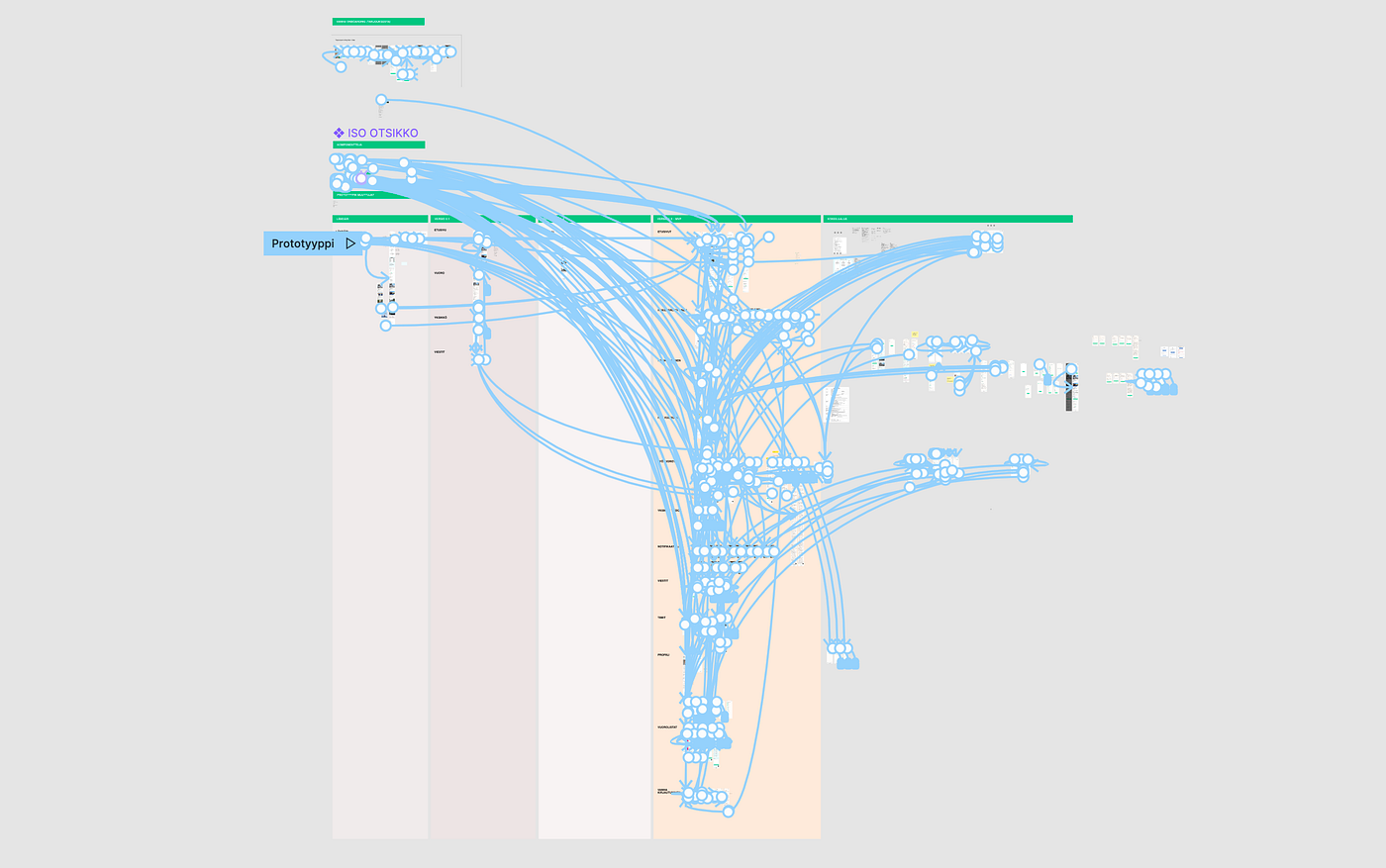
When the time is up, you just scrape it together. You have to simplify it in the wrong places so that it feels like a compromise between your vision and conventional design elements. The developers find it difficult to implement, and in the end, nobody is happy with the result — the least you.
What Do the Researchers Say?
Let’s analyze a bit what happened during the design process above. The stress levels at the end of the design were super high. The stress hormone (cortisol) is making you focus on the delivery and suppressing your creativity. You resort to conventional design patterns that you know have worked before.
There is indeed a large scientific body of literature on the impact of stress on human psychology and physiology. It is quite a complex matter, so here I’m just summarizing some of the findings. If you are interested in digging more into the effects of stress on creativity, have a look at the articles in literature section at the end of this post.
Kristen Byron et al [1] found that in general, low stress-inducing situations cause an increase in creative performance and high stress-inducing situations cause a decrease in creative performance. Plessow et al. [3] note that “stressed participants showed tonically increased goal shielding (to reduce interference) at the expense of decreased cognitive flexibility”.
It seems that especially social-evaluative threats are causing stress. This happens when your work is under evaluation by other people and you are being compared (negatively) to other people. Does this sound familiar? At the end of the day, your work is reviewed by all stakeholders: developers, managers, peers, and most importantly of all, the end-users.
Dickerson et al. [4] state that low social-evaluative contexts increased creative performance, where social-evaluative threats were considered to “occur when an aspect of self is or [can] be negatively judged by others”.
All in all, it seems that a little bit of pressure is good for you, but high stress and especially in social-evaluative situations will kill your creativity.
How to Avoid Design Stress?
Have you found yourself struggling to get all the bits and pieces in your design in place, when you started with an ambitious vision? The deadline is approaching fast and you should present a working solution in just a few days. What a stressful moment that is!
I have found it very useful to start with designing a Plan B first. I sketch the first solution using standard design patterns and conventional UI components. This is not necessarily a beautiful and elegant solution, but something that I know will certainly work. Depending on the task, this first design can possibly be done in just a few hours.
When you know you have a solid Plan B, you are free to explore something novel.
When this is ready to the extent that I can be confident that with a little bit of finishing this will be a decent solution, I know that have a solid Plan B that I can always revert to. This is a big relief. I can stop worrying about the approaching deadline and the social pressure of delivering something that the developers can start working on.
Now I can start exploring new, much more creative design options. Designing the Plan B first has unleashed my creativity.
The Case of the Analog Time Picker
At one point in history, I was heading the UX design of a new mobile platform at Nokia. We started this line of products from scratch so we needed to design the hardware UI (touch, buttons), UI components and the operating system UI (like Android or iOS), and all the apps at the same time. This has been the most complex and interesting ask I’ve encountered so far in my career. This was such a high pressure environment that I practically had no other choice than use the idea of the Plan B.
Let’s look at one of the apps that we worked on: the clock. We wanted to design the best clock app on the market. To start with, we designed the simplest UI that we can think of for the basic functions: displaying and setting the time. Our first design for setting the time was just spinner controls for the hours and minutes (see Figure). This we were able to sketch out in maybe half an hour. After this we were confident that if anything else fails, this is a concept that we know we can finalize to fulfill the functional requirements.
After this, together with Annina (👋), the designer responsible for the clock app we started to explore much more elaborate and elegant solutions that draw inspiration from analog watches (see figure). Designing the the interaction that mimics setting the time on the face of an analog watch is by no means straightforward (see if you can spot some of the challenges!).
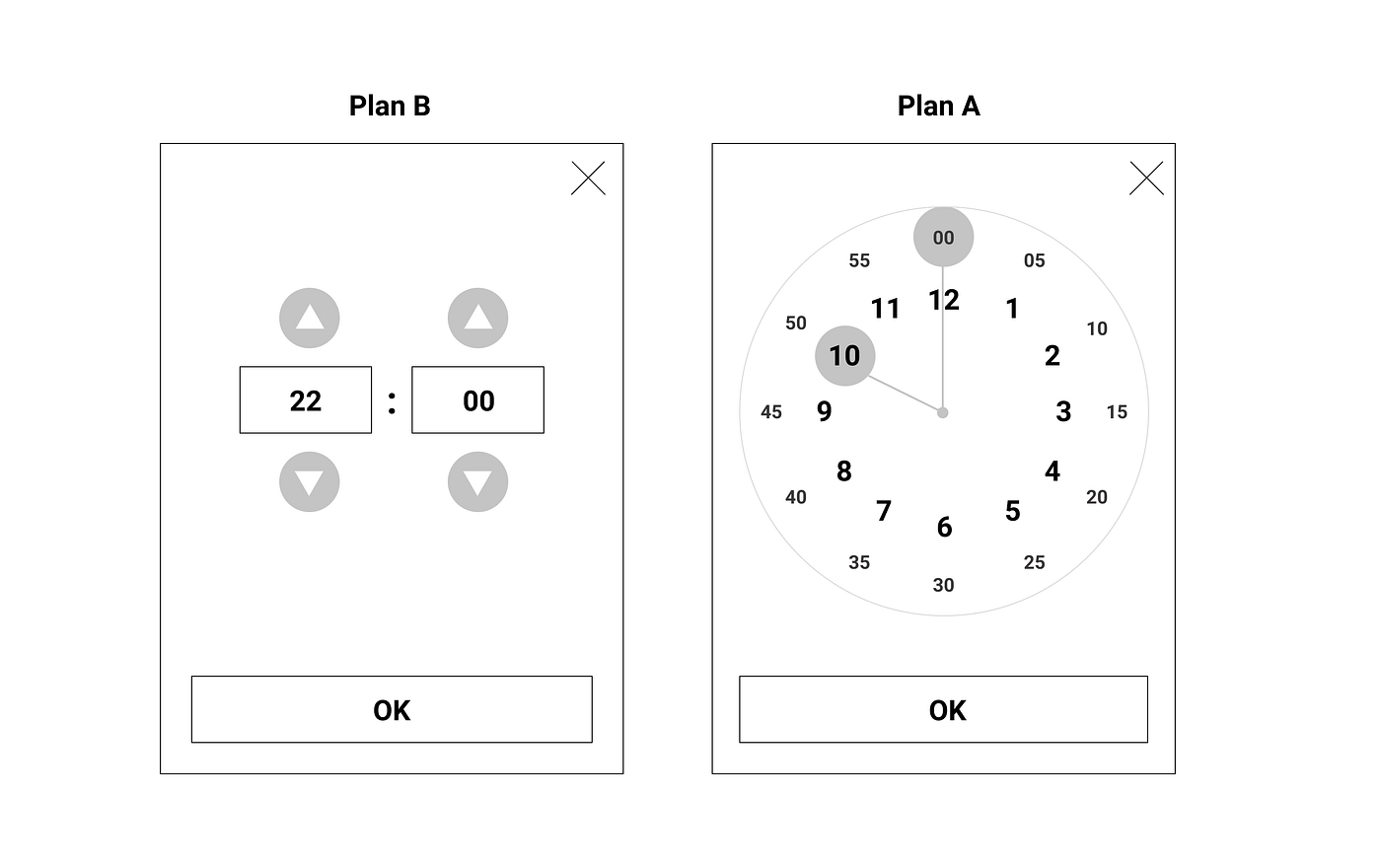
We weren’t confident that the path we had chosen would lead to a usable and elegant solution before we hit the deadline. However, we knew that we had the Plan B that we could always revert to. This removed the pressure and we could instead enjoy the exploration towards a much more elegant solution. The result was one of the iconic apps of the Nokia N9 mobile phone. (All credit to Annina & co, I had left the company before the release.)
Conclusions
Creating a stress-free environment for a designer is essential if you want to create solutions that are beyond the obvious. There are many ways you can help foster creativity, but for me, one of the easiest ones has been the approach of designing a Plan B first and then moving on to exploring new directions and designing something genuinely novel.
As a sidenote: this approach is directly linked with the idea of early sketching described in one of my earlier blog post “Let the Designers Design” [7].
Literature
[1] “The Relationship Between Stressors and Creativity: A Meta-Analysis Examining Competing Theoretical Models”, Kristin Byron, Deborah Nazarian, Shalini Khazanchi, 2010
[2] “Ways to Activate Your Diffuse-Thinking Superpower“, Eileen Purdy in Highbrow
[3] “Inflexibly focused under stress: acute psychosocial stress increases shielding of action goals at the expense of reduced cognitive flexibility with increasing time lag to the stressor”, Franziska Plessow Rico Fischer, Clemens Kirschbaum, Thomas Goschke, J Cogn Neurosci. Nov 2011
[4] “Acute Stressors and Cortisol Responses: A Theoretical Integration and
Synthesis of Laboratory Research”, Sally S. Dickerson and Margaret E. Kemeny, in Psychological Bulletin, 2004
[5] “Acute Stress Shapes Creative Cognition in Trait Anxiety”, Haijun Duan, Xuewei Wang, Zijuan Wang, Wenlong Xue, Yuecui Kan, Weiping Hu, Fengqing Zhang, 2019
[6] “The Creative Brain Under Stress: Considerations for Performance in Extreme Environments”, Oshin Vartanian, Sidney Ann Saint, Nicole Herz, Peter Suedfeld, 2020
[7] “Let the Designers Design”, Panu Korhonen, 2021