Introducing new technology to the market
Introducing new technology to the market
Why do some technologies succeed and some fail to get traction? When you invest in new technology, you have different strategies on how to integrate it into your existing products and bring it to the market. In this post, I will present a framework that will help you plan your go-to-market approach.

New technology framework
New technology can have various kinds of value. Some people are interested in the technical advances per se. They want to have the social status related to latest technology, even if the practical, functional benefits are small. Typically, however, new technology is introduced to either qualitatively improve the current functionality of products, or to enable new functionality that has not been possible before.
Examples of the former could be faster processors in smartphones: they don’t directly enable new functionality but they make the usage of the phones snappier and more pleasant. For the latter, the history of technology is full of success stories (note the survivorship bias). For example, real-time dialogue over distances was impossible before the introduction of the telephone.
To complete our framework, we also need to take into account the development of new functionality that doesn’t require any new technology. For example, after the technology enablers of smartphones and wireless internet have been put in place, all new functionality introduced with new apps belong in this category: they provide new functionality essentially without any new technology.
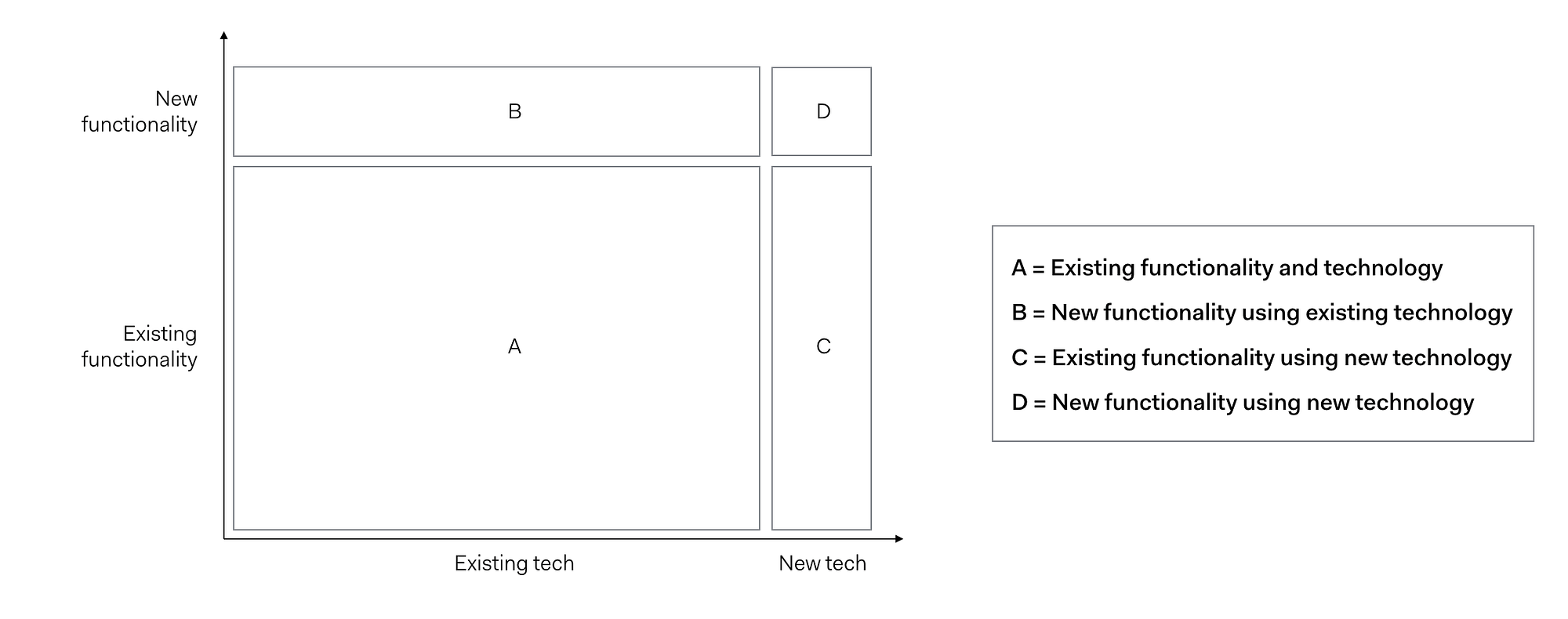
With these definitions, we can form a framework for introducing new technology to the market. It consists of axis for existing and new functionality and for existing and new technology. The framework is presented in the following figure 1.
Introducing new functionality without new technology
Your current product or offering is in the lower left quadrant. When you evolve your product, you can enable new functionality, you can introduce new technology, or sometimes you can do both at the same time. Naturally, you can also reduce functionality because of tactical reasons or to simplify the product for better user experience, but that will be another story.
Moving from quadrant A to B is a typical evolutionary design thinking or product development project. You do the research with your target customer groups and build new functionality to serve the needs and motivations that you find.
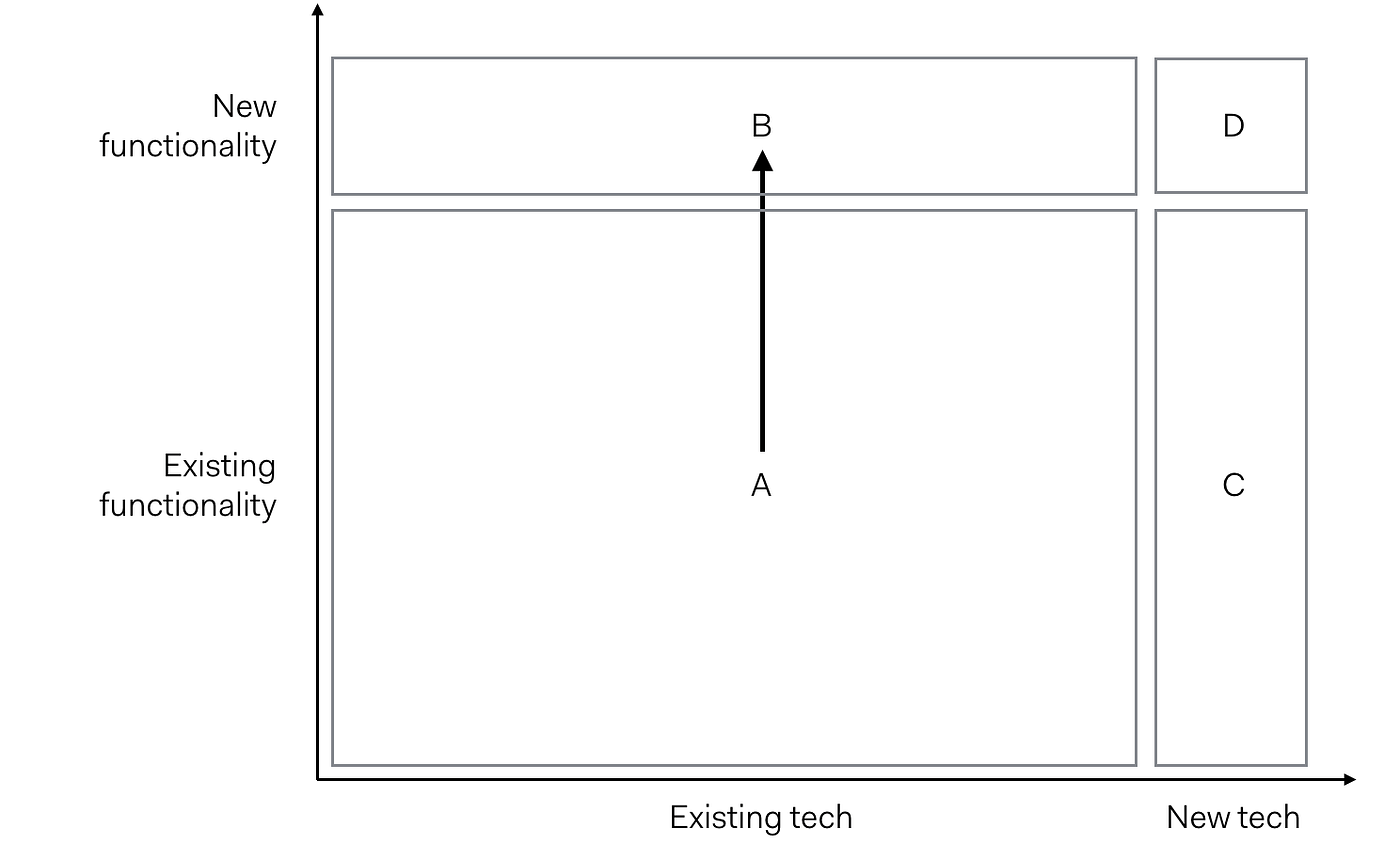
If you do this carefully, you reach potentially high benefits with low additional development cost, and therefore a good opportunity for significant revenue. The value proposition for the customers is typically relatively easy to communicate and easy to understand.
Examples of this kind of product evolution are most of the new smartphone applications that you see in the app store. They hardly use essentially any new technology but utilize the ones already existing in the smartphones, wireless connectivity and in the backed server solutions.
Introducing new technology without new functionality
The second category of technology evolution is to introduce new technology in order to improve the user experience qualitatively.
Why would you do this? It seems slightly counter-intuitive, but this is actually done quite frequently. The new technology is used to make current functionality or services smoother.
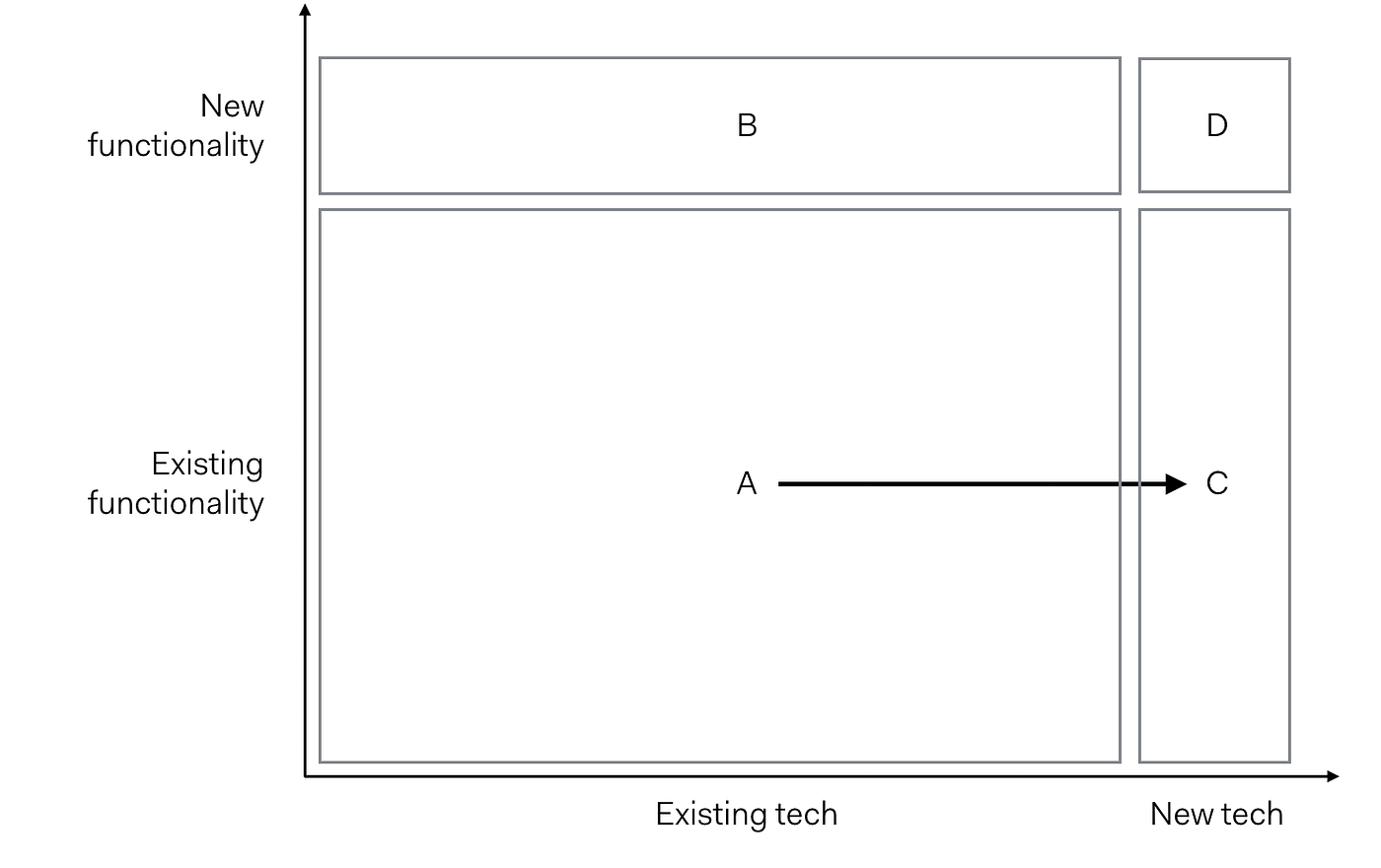
One example of this category is the experimental facial recognition for payments in retail shops. Mobile payments are already possible and relatively easy: you can swipe a mobile point-of-sales terminal with your RFID enabled credit card, with your smartphone or your watch. The evolutionary step by introducing facial recognition for payments is that you don’t need to dig out anything from your pocket (not that your smartphone wouldn’t be in your hand all the time anyway…) nor twist your left arm with the watch to the terminal. This is a small qualitative improvement to the existing payment functionality, enabled by new technology.
The good thing about introducing technology in this way is that the value proposition for the consumer is really easy to understand: they already know the value of the current functionality, and now it just got better. However, as this is still a qualitative improvement, they might be wondering if the better usability is worth the cost.
New functionality with new technology
In the long run, your goal must be to enable new functionality with new technology, in order to provide a superior product and competitive advantage. However, it is not completely obvious, which is the right strategy to get there. You can aim there directly, or take steps by introducing either new functionality or new technology first.
The straightforward strategy, aiming directly to quadrant D by introducing new technology and new functionality simultaneously can be challenging. You need to convince the customers to invest in new technology and at the same time renew their practices and usage patterns in order to utilize the new functionality.
You will need to convince your customers that the new technology will provide some really useful functionality before the customers have much evidence of this. The value proposition can be difficult to communicate. There’s a risk that the technology will be perceived as just a gimmick or to be too difficult to grasp. It also requires a heavy investment from your side for both the development and for the marketing and communications about your product.
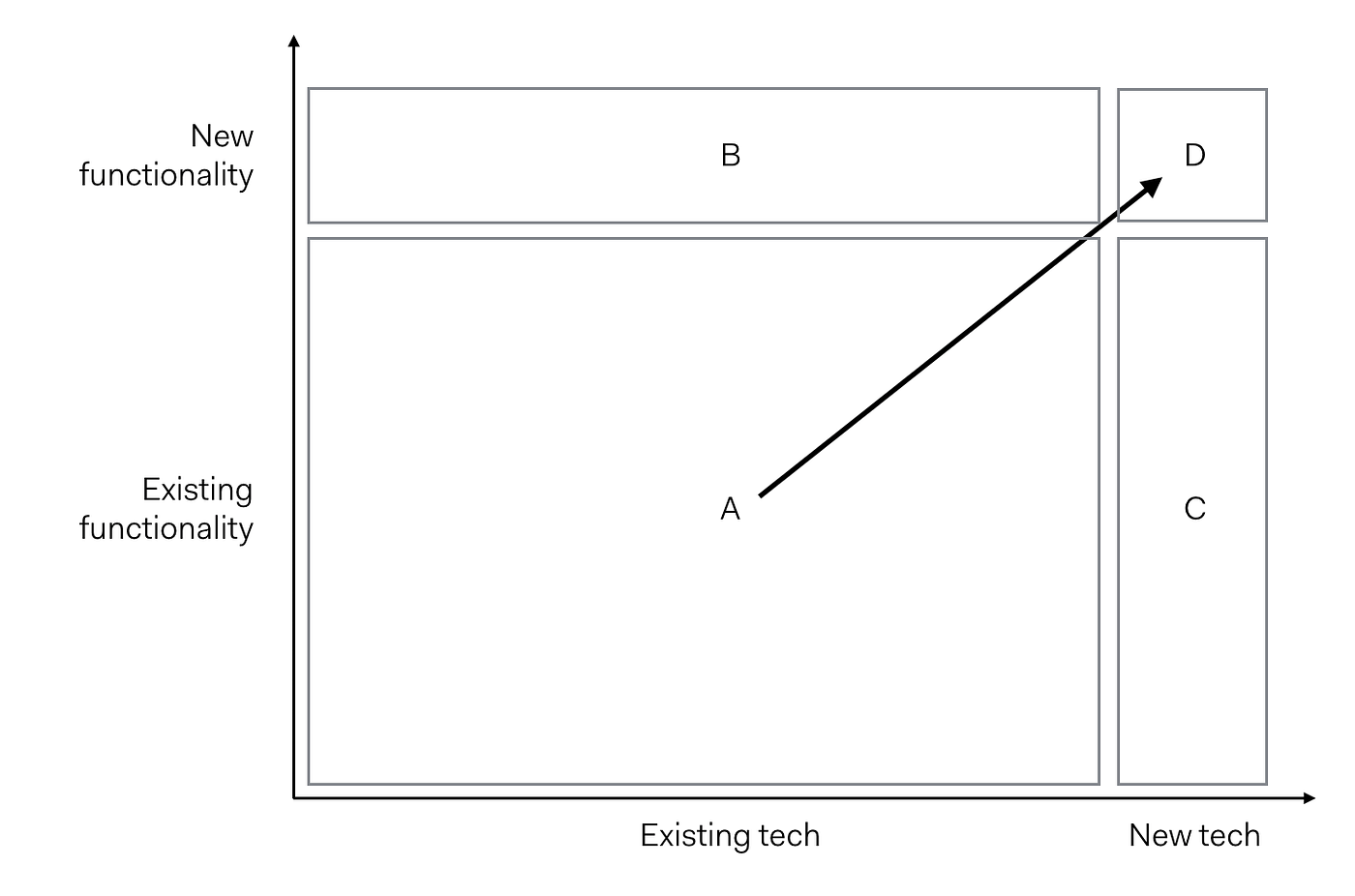
However, just like in any action plan that based on a long-term strategy, you don’t need to aim directly to your desired state. You can choose to get there through determined smaller steps.
The first alternative strategy is to introduce the new functionality first, and then provide the technology as an add-on to improve the functions. See the Figure 5 for the illustration for this.
An example of this could be a sports tracking system, where you first develop functionality in an application that works on the existing hardware of smart phones. This step can be provided relatively cheaply to the customers, because they don’t yet need to invest in new hardware. In the second step, you introduce a hardware companion to the app that will improve the accuracy of the tracking and measurements.
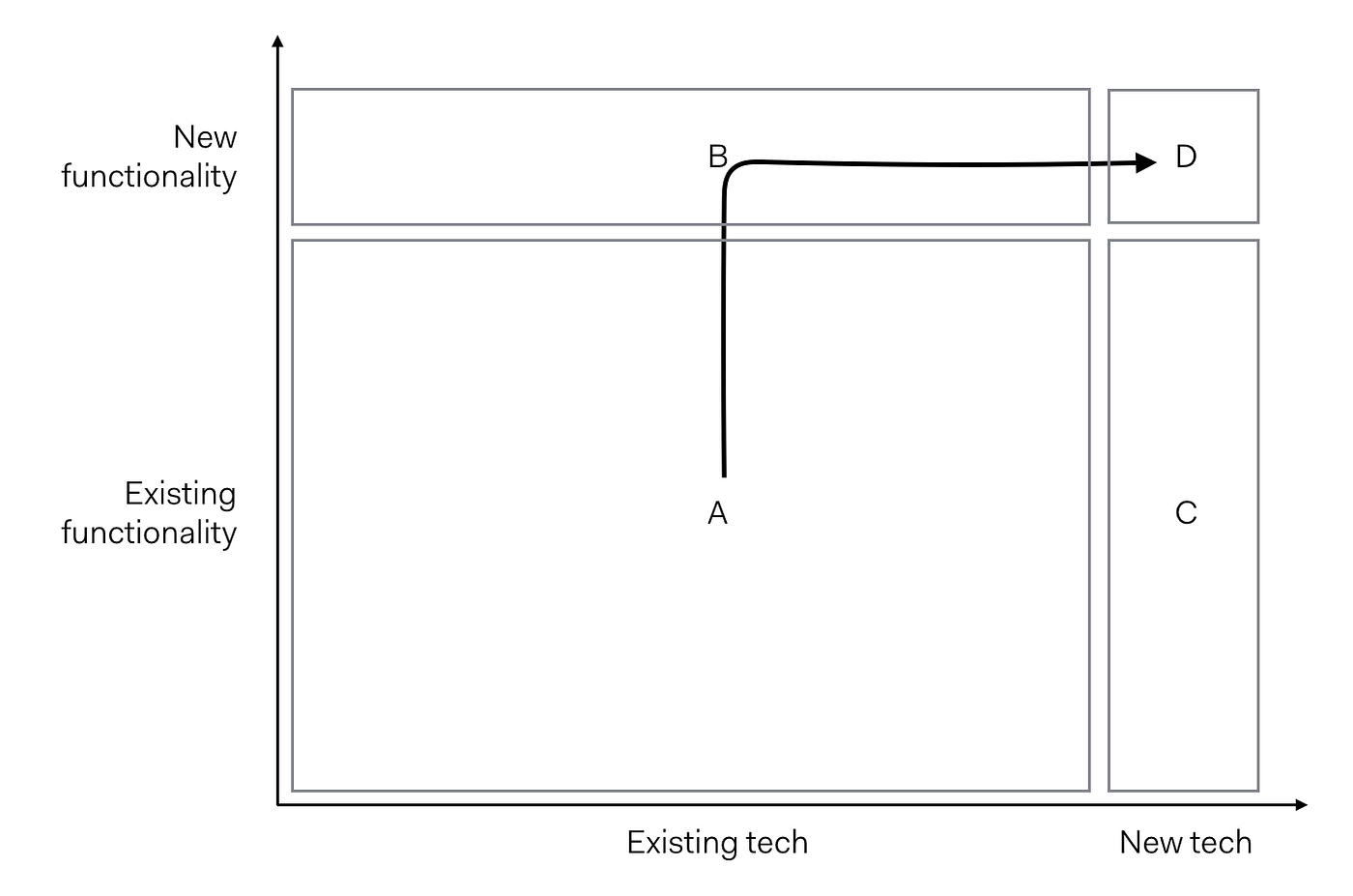
In this strategy, you can reach a large consumer base that tries out your new functionality for free or for a small cost. This is the primary target audience for your hardware add-on that you can sell with a healthy margin.
If you would try to sell the new technology and the new functionality in one go (i.e. try reaching D directly), you’d have a much harder sell.
The second alternative strategy is to introduce the technology first as an improvement to the current functionality, and afterwards build new functionality on top the technology your customers already have. An illustration of this strategy is presented in Figure 6.
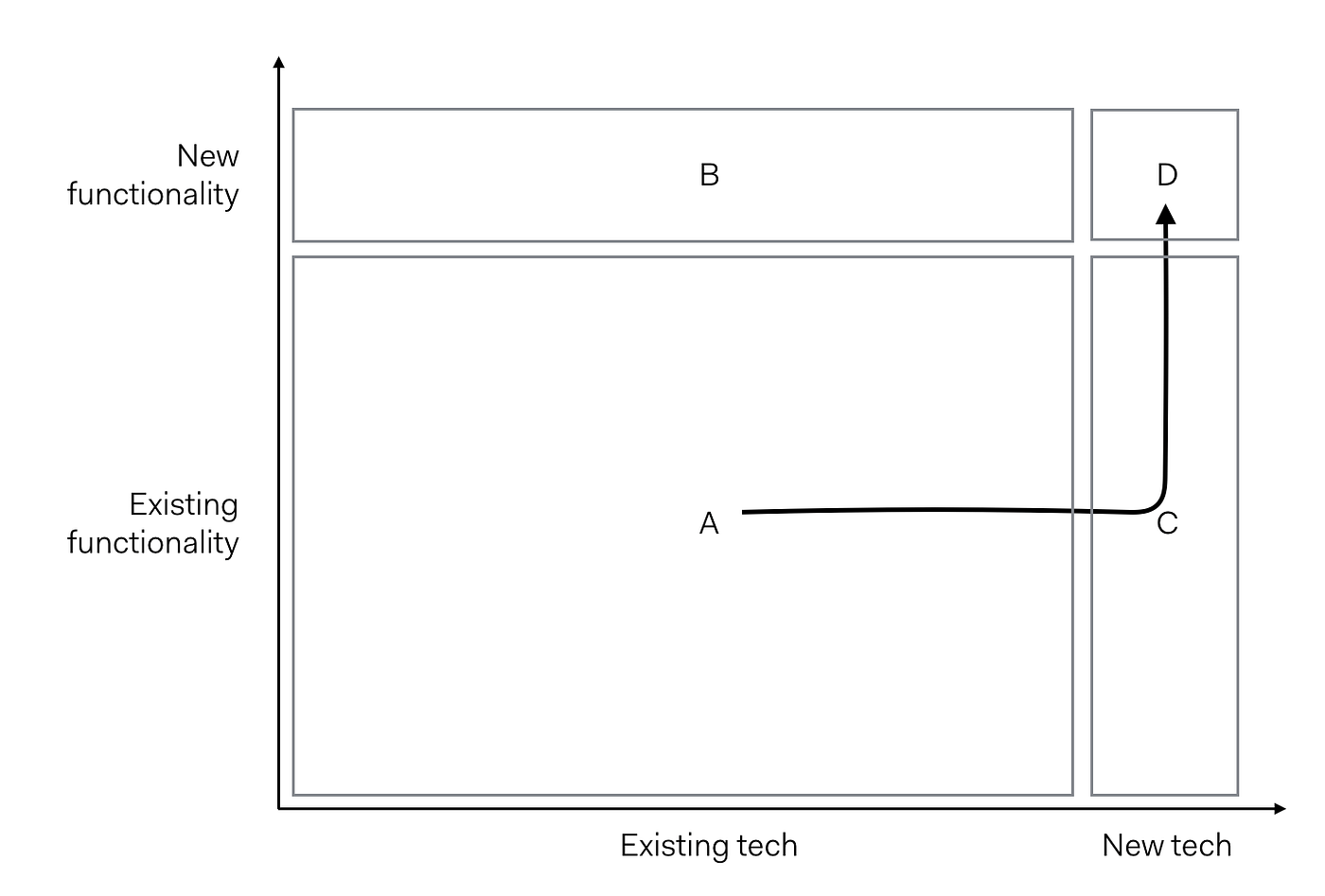
One example of this strategy is an electric vehicle (EV) manufacturer. An EV uses completely new technology, yet it provides very familiar car features. Later, the EV manufacturer can upgrade their cars with self-driving features for additional premium price. The consumers won’t need to upgrade any of their (hardware) technology, and gain new functionality on top of the technology that they already have learned to trust.
Another example could be a smart home system provider, who wants to introduce a full smart home system to people’s homes. It will likely to be easier to first sell one simple functionality, for example an air quality monitor, but bundle it with a smart home hub, yet keeping the price low. The provider can later on monetize on this investment in the hubs by providing further functionality to the home hub with only little or no additional hardware at all.
Conclusions
This framework is a model for you to review your choices what comes to introducing new technology to the market. First, state your end goal with your future functionality and technology as in quadrant D.
As illustrated in the chart, quadrant D is likely to be relatively small compared to the existing product functionality and technology. You may have difficulties in convincing yourself and your company that the technology development is useful only for the new functionality. Instead, plan for your roadmap to go through quadrants B or C. If you use your technology development to improve many or all of your current features, you will have a lot more leverage for the technology. Similarly, if you build new functionality on top of your existing tech, you can move ahead faster, and introduce the new technology as improvement later.
Plan wisely and don’t leave your customers behind.
At Nordkapp we work in close partnership with our clients to design feasible, viable and beautiful interactive products and services. If you are interested, drop us a line.