Re-thinking design thinking part I: Introduction

Re-thinking design thinking part I: Introduction
The current design thinking process is rigid, slow and focuses on wrong things. The way we design is already much more advanced and agile than our current vocabulary and visual representations of the process. They have become a limitation for design, therefore it’s time to give up the old models and start redrawing the new design process.
Free your mind
This is the first in a series of blog posts that will take you through a journey of first describing what is wrong with the current process models, then presenting elements of the new design process, and lastly formulating an initial framework for the new process model.
This will not be easy, because we are so accustomed to the present model. It’s difficult to describe the future with the vocabulary of today. Therefore I ask the readers to try to be very open-minded, think about your experiences of what is actually going on in the design process instead of what you think should be happening. Free your mind and the rest will follow.
Million files can be wrong
The ubiquitous design thinking or human-centric design (HCD) process (they are virtually the same) has been the dominant model for designing digital and interactive systems already for four decades. There’s surprisingly little criticism and discussion about the process in the design community. If you google around, you will see that all process models portray the same picture, with insignificant variations. Have we found the ultimate process model for design, or are we too busy designing that we don’t have the time and energy to develop our process further?
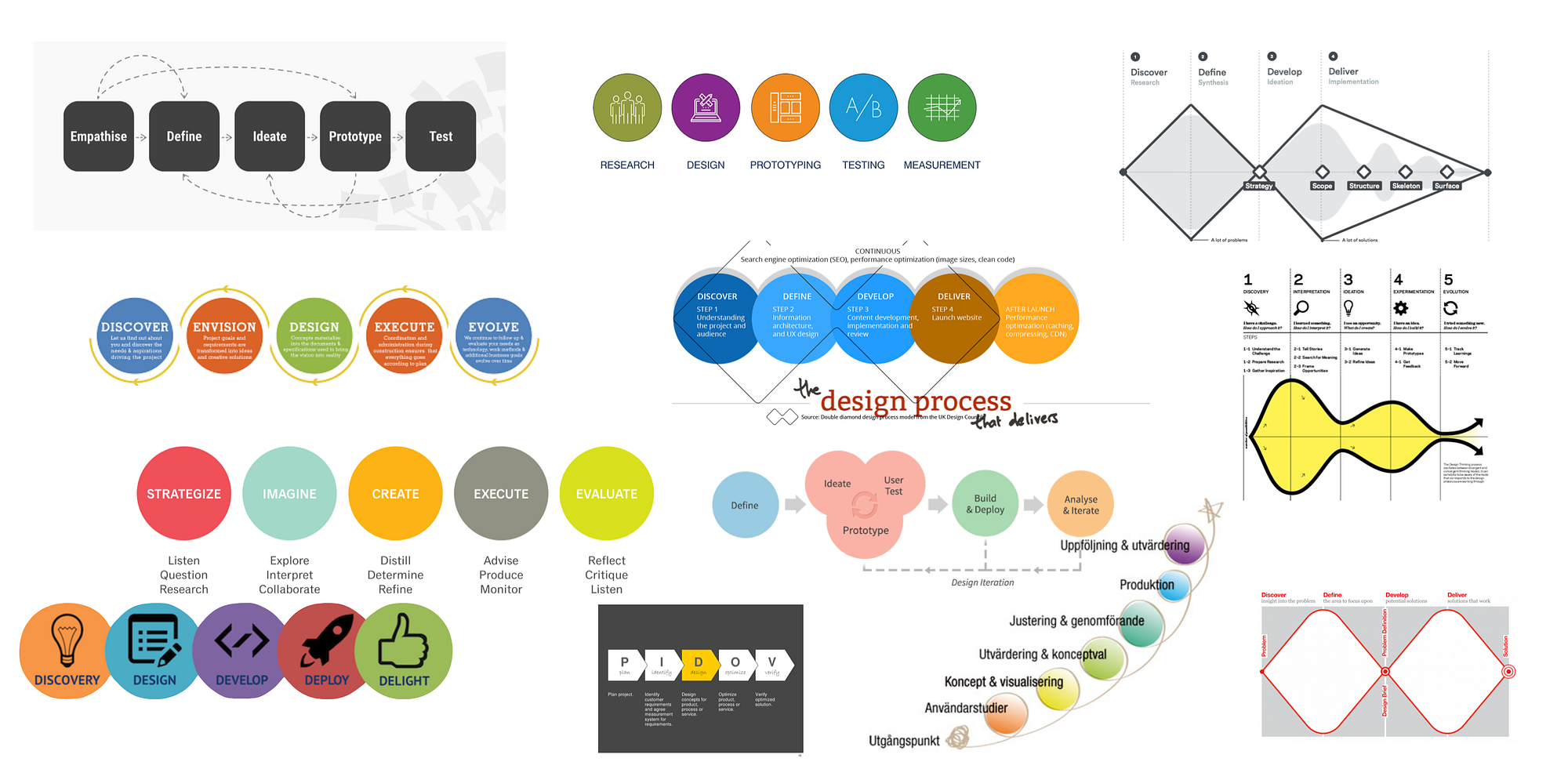
The 5-phased design thinking process (with minor variations) is currently so deeply ingrained in the design culture that it seems that designers can’t think beyond it. On the contrary, it is such a strong practice that it makes us to retrofit all of our design processes to it, and therefore it is a limiting us how we design. If we can break free of this one rigid model, we can unleash a tremendous amount of new designer potential, creativity and effectiveness.
I have for some time felt uneasy about this dominant process and how it limits how we might optimally want to do design. To my surprise and great satisfaction I recently found several articles written by the wonderful professor Gilbert Cockton from Northumbria University. He has been doing research on the new design process for several years. His research and publications resonated very well with my own findings and inspired me to study the area further. Please do have a look at his writings, highly recommended!
We are prisoners of our vocabulary
Why would the process models that we use be so important? Would we in any case apply and modify the models to our work, and do the necessary iterations and deviate when needed?
The models, visualizations and vocabulary are our tools for thinking. The intent of a process model is to make planning faster and better: a predefined, tested model is likely to be better than an ad hoc process especially if not planned by an experienced designer.
When we take an existing process model as a starting point and start planning our own design project according to it, we will inevitably force-fit our plans to the model. The current model invites us to always start from problem definition phases even if our definition would be relatively good and ready. It holds us off from creating design ideas early in the process, although opening up the domain with initial brainstorming right at the start might be very useful.
The same applies to words. In design textbooks, the design process starts from a “problem”. But what if we don’t have a problem but an opportunity, or a domain that needs new ideas, or a new service that we want to make even better? If we want to start with a problem, we may overlook other starting points for design that could be much more fruitful than solving a problem, where by definition we are satisfied when we have eliminated the negative, whereas we should be turning opportunities into something positive, something unexpected. Every word has baggage: they carry associated meanings that may not be appropriate to the task at hand.
We have to be aware of the visualizations and vocabulary that we use. We cannot allow that these start limiting or misguiding our thinking and our ability to do design in the optimal way.
Stay tuned
In the next blog posts I will walk you through more in detail why I claim that the current design thinking process is slow, rigid, and focuses on wrong things. Then I will proceed to open up the elements that we can use to reformulate the process. At the end, I will provide some tools that you can use to start defining the new process model. It will be a long journey and won’t be easy for you. It is also not yet easy for me to express in words. I hope I will be able to provide some ingredients of the new design process, and hope that you will join me collectively in re-thinking the design thinking.
(To continue the journey, proceed to“Re-thinking design thinking part II: What is wrong with the design thinking process”)
References
- Dilemmas in General Theory of Planning. Horst Rittel, Melvin Webber, 1973
- The New New Product Development Game, Nonaka & Takeuchi,1986
- Design isn’t a Shape and It Hasn’t Got A Centre: Thinking BIG About Excellences in Post-Centric Interaction Design, Gilbert Cockton, 2013
- New Process, New Vocabulary: Axiofact = A_tefact + Memoranda , Gilbert Cockton, 2017
Panu Korhonen is a designer at Nordkapp who sometimes wonders why things are done the way they are done.
In his projects he wants to create designs that save the world.