Re-thinking design thinking part III: Ingredients of the new design process
·

Re-thinking design thinking part III: Ingredients of the new design process
The current design thinking process is rigid, slow and focuses on wrong things. In the previous posts I’ve described the many ways in which the current design thinking process is limiting our design. Next, let’s look at inspiration and elements that we can use to re-define the process.
Design arenas
Earlier I discussed that there is very little emphasis on the results of the different tasks and phases in the design thinking process.
The “problem” as a starting point for the design process will already contain some initial understanding of the stakeholders (e.g. users), a plan for what kind of impact we want the new “solution” have on them, and most often also initial ideas for the solution. Similarly, the results of the design process will consist of a plethora of other things than just the final artefact.
All relevant design projects handle wicked problems. Rittel claims that for those, you cannot define a problem without a solution, and that you actually never finally solve anything.
It turns out that the inputs, intermediate results and the outputs of the design thinking process are actually just evolving knowledge of different aspects of the design. Gilbert Cockton calls these aspects design arenas.
The four design arenas are:
- artefacts: the intangible or tangible, physical or digital aspects of the results. These are typically the results that you associate with the word design in the traditional sense
- beneficiaries: persons or entities that benefit from the results of the design (alternatively if they rather suffer they can be called maleficiaries.)
- purposes: what should the end state be after introducing the artefacts to the world. What are they for and how do they benefit the beneficiaries?
- evaluations: plans, activities and results where we analyse how the artefacts (or prototypes of them) fit the purposes for the beneficiaries
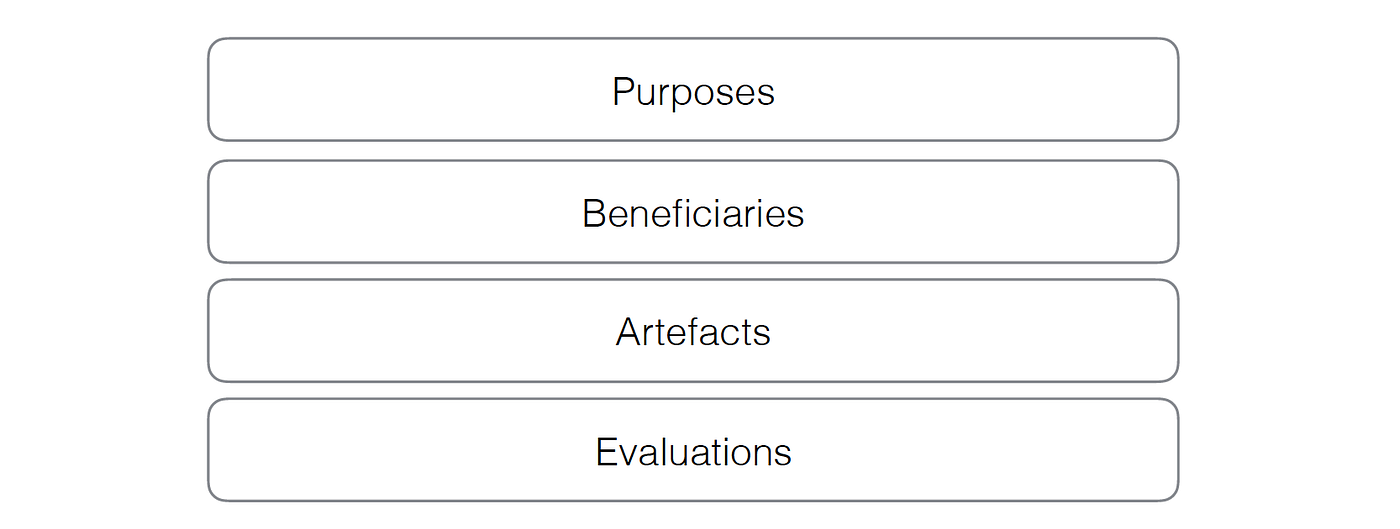
As mentioned earlier, the starting points for a design process typically consists all of the design arenas at the same time. For example, it is very rare to start with purposes and beneficiaries without having any initial idea of the artefacts. Many projects actually start with a technology or artefacts trying to find a purpose and matching beneficiaries. Sometimes the process starts with an evaluation of an existing or a new system, or simply an artefact that needs a renewal.
Similarly the results of the design process consists of all of the design arenas. In addition to the artefacts, you will have defined the purpose, increased understanding of the beneficiaries, and verified that all of them match with evaluations. As we know of wicked problems, you still don’t have a “solution”, but you will have new or revised artefacts, a hypothesis that they are a better match for the purpose, you know more about the purpose and beneficiaries, and you also know more of what you don’t know.
Different design traditions
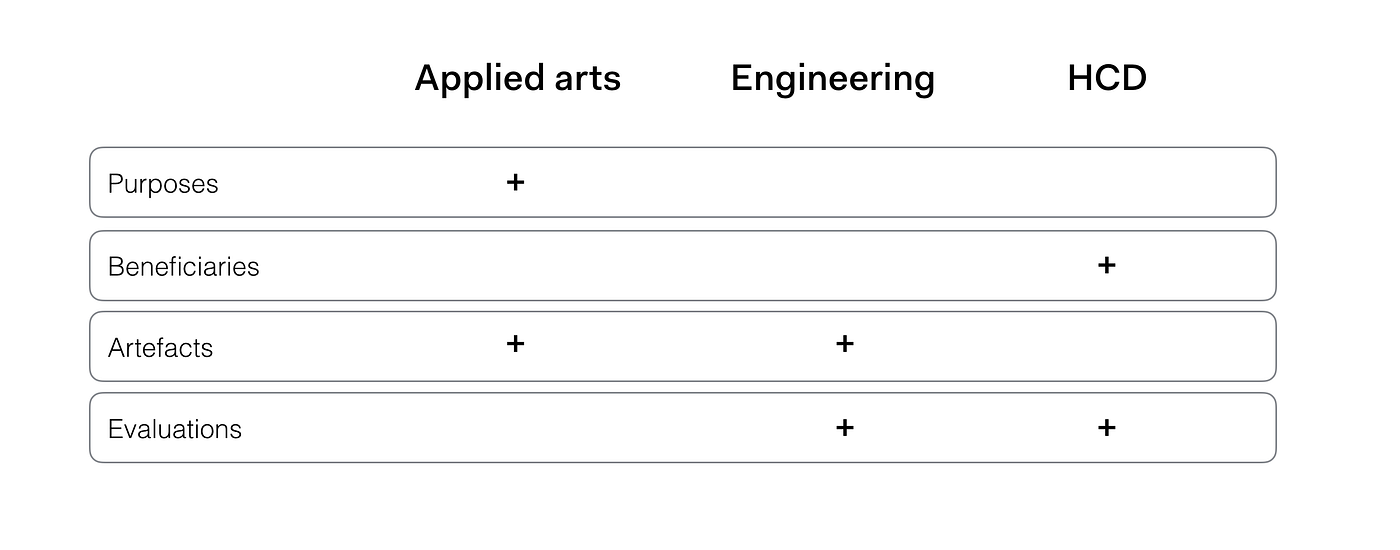
According to Cockton, there are (at least) three different design traditions that approach the design process in quite different ways: applied arts, engineering and HCD/design thinking. None of these is the right one or the wrong one. They are different, and excel in different aspects of the design, and we should learn from all of them.
Artefact centred engineering
Before you ask: engineering is also mostly design. For example, mechanics design and software design are design practices that heavily rely on science: theories, measurements and validations. Nevertheless, engineers don’t have a mathematical formula or an algorithm that will automatically spit out a perfect result. They apply known theories, but the problems they are tackling are so complex that they must use their intuition and experience to create solution proposals that then can be validated against set criteria. Engineering is very thorough in the validations: both mathematical modelling and experiments to test if the designed prototypes and artefacts pass the set criteria. The artefacts are then refined, optimised and iterated until the required criteria are met.
What engineering design typically misses is the complexity of the problem setting. It is very good at finding answers to questions, but not very good at defining what the right questions should be. Engineering is all about the solution: a physical or digital construction. It is very much an artefact centric design discipline.
Designer centred applied arts
In applied arts, the sole purpose for the design process is to create artefacts that fulfil the vision of the designer. The artist is mostly free from external target setting, nor is the work never modified because of audience feedback, or mostly ever critiqued before it is released. Artists generously try out things outside any initial brief, and only after creating the first incarnations of the vision, they subjectively evaluate if this direction is of any interest to explore further. The design process of applied arts is very much designer centric.
The design process is however often very iterative. The ideas are developed sometimes over long periods of time.The process also consists of intimate relationship with the materials. A sculptor is inspired by the material she is working with and at the same time challenged to overcome the limitations of it. The artist expresses herself with the materials, and the material talks back to her.
User centred HCD
I’m sure the human centricity of design thinking and HCD is quite obvious for the readers of this blog. It suffices to say that design thinking process wants to understand the needs and motivations of the beneficiaries and to ensure that the artefacts meet the needs with iterative evaluations with the same groups. It is very much centered around beneficiaries.
Gaps in current design
Each of the existing design traditions focus on different design arenas: applied arts on purpose and on the artefacts, engineering on evaluations of the artefacts, and HCD on the beneficiaries (e.g. end users) and on the evaluations. Each of the design traditions therefore have also blind spots that they have unintentionally — or sometimes intentionally — ignored.
The new design has no centre
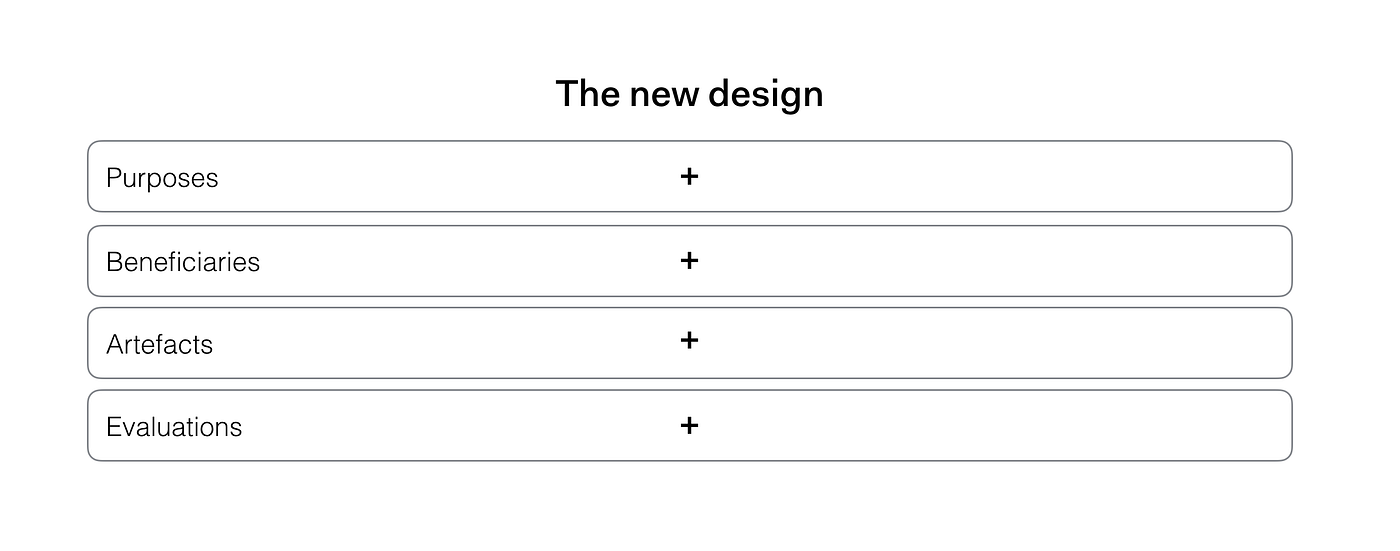
The new design process will need to adopt the strongest aspects of the different design traditions. It will have equal emphasis on the purposes, beneficiaries, artefacts and the evaluations. It will define an in-depth and insightful purpose, it will unleash the exploration power of the unconstrained ideas in the applied arts, it will analyse the needs and motivations of the beneficiaries, and it will thoroughly validate that the beatifully engineered artefacts will fulfil the purpose for the beneficiaries.
Stay tuned
In summary, the new design process will cover purposes, beneficiaries, artefacts and evaluations equally. It will start with the four design arenas, evolve them until they are good enough or until it runs out of resources and time. It will be a balanced process without a centre, using the strongest elements of different design traditions.
These will be the key concepts for the introduction of the new design process. For that you will need to turn to the next and final blog post in this series.
(To continue the journey, proceed to Re-thinking design thinking part IV: The new design process)
References
- Dilemmas in General Theory of Planning. Horst Rittel, Melvin Webber, 1973
- The New New Product Development Game, Nonaka & Takeuchi,1986
- Design isn’t a Shape and It Hasn’t Got A Centre: Thinking BIG About Excellences in Post-Centric Interaction Design, Gilbert Cockton, 2013
- New Process, New Vocabulary: Axiofact = A_tefact + Memoranda , Gilbert Cockton, 2017
Panu Korhonen is a designer at Nordkapp who sometimes wonders why things are done the way they are done.
In his projects he wants to create designs that save the world.