Re-thinking design thinking part IV: The new design process
·
Re-thinking design thinking part IV: The new design process
The current design thinking process is rigid, slow and focuses on wrong things. In this series of blog posts I have so far shown why, and then presented elements that we can use for forming the new design process. In this last post I will summarize what we know so far about the new design process. It will be a long journey before it will settle down, until we find concrete forms, visualizations and tools to support it, and until we get accustomed to the new vocabulary.
Balanced, not centric
The new design process will not have a centre. It will be balanced process, where the different design traditions are merged to combine their strongest parts. Be inspired of the generosity, intuitiveness, and purposefulness of the applied arts. Take the beneficiaries into account as rigorously as in the design thinking process. Evaluate, iterate and focus on creating artefacts like engineering design. Break the silos. Go to a different conference or exhibition this year.
Four design arenas
The new process starts with the four design arenas. Write down what you think you know about the current and planned beneficiaries, artefacts, purposes, and evaluations. Observe especially what you don’t know for each.
During the design process you evolve the four design arenas. Use all the methods that you see appropriate: study the beneficiaries in order to understand their lives to inform your purposes. Explore with the designs of new artefacts to find out more questions and ideas for the purposes.
Use prototypes of artefacts for evaluations with the beneficiaries, to further understand their lives and inform your purposes. Evolve your artefacts towards results that fulfil the purposes for the beneficiaries.
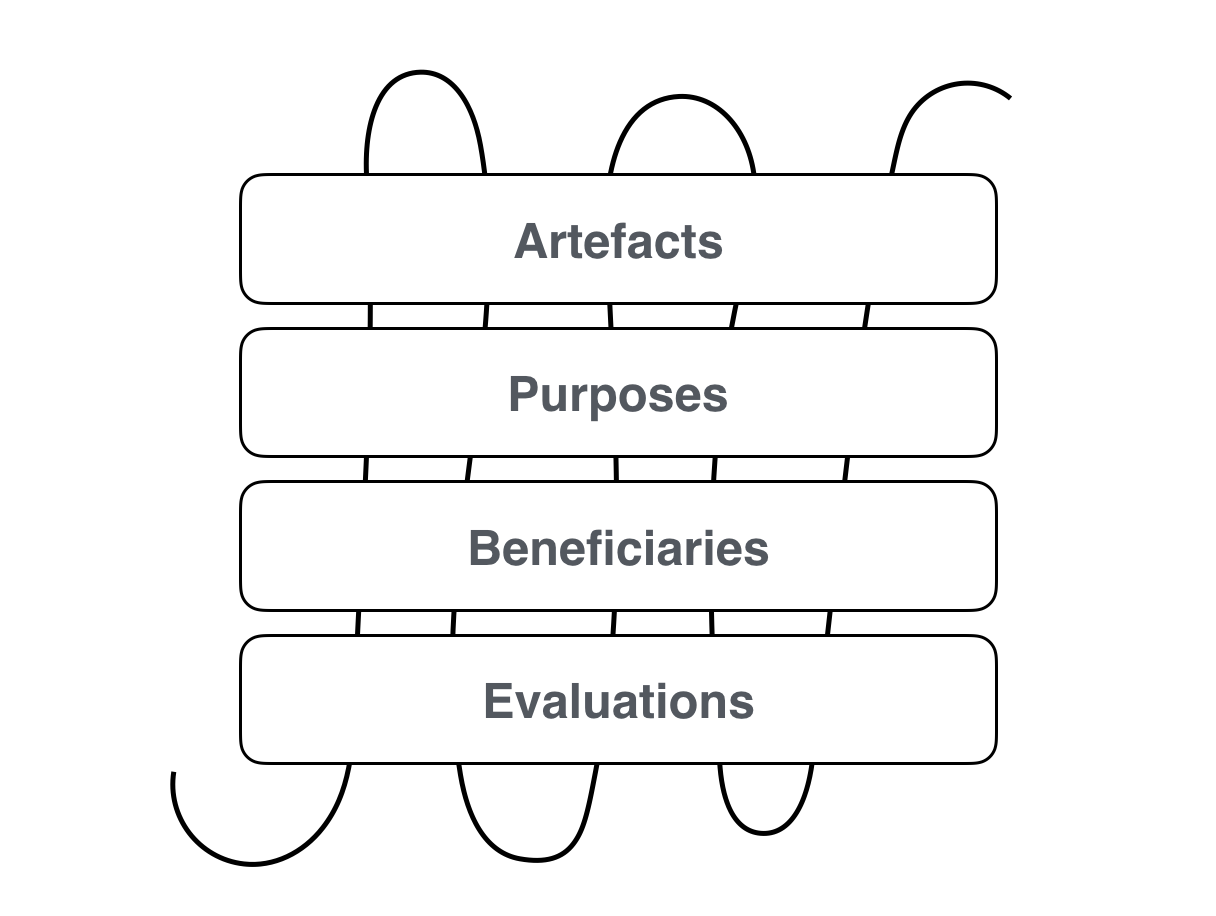
When you run out of time and resources and have the final artefact in place, remember to reflect back to the beneficiaries, purposes and evaluations of what your hypotheses for the future are and what questions the results will still leave open.
Be generous
When you are creating ideas and solution proposals, be generous and unlimited, like applied arts. Proposals that stretch the other arenas, like radical product ideas, new purposes or surprising beneficiaries, may open up completely new opportunities that you wouldn’t have looked at otherwise. Don’t be afraid of using designer intuition or define purposes beyond the original brief. Sometimes it’s completely OK to be a little designer centric.
Be as rigorous in developing the artefacts as the engineers. If you cannot get them out there, mostly you will not reach the purpose that you ended up with. Base your designs on well-known theories, create hypothesis, develop prototypes, run experiments, and iterate towards the optimal artefact like an engineer.
Defining the order on what to work on
When you don’t have a waterfall process to follow, it’s often not clear what you should do next.
For the new design process, it is difficult to give any specific advice, how to decide what to do next at any given time in the process. You will certainly need to consider the time and resources that you have (left) for the project, which will help you decide how rigorous methods you will be able to use for each of the arenas.
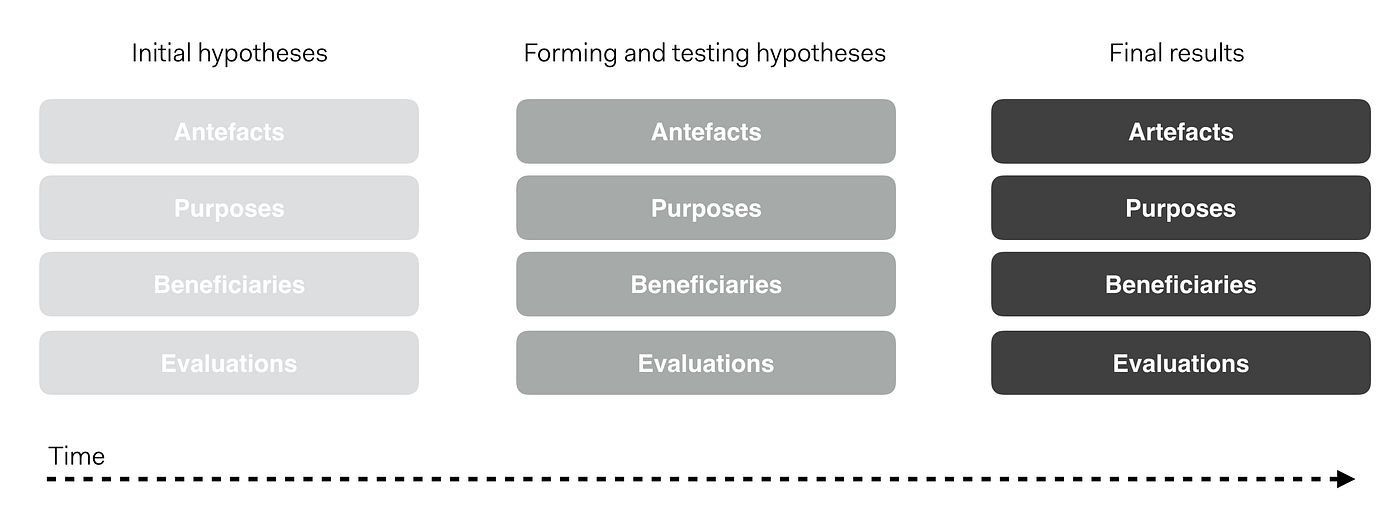
Remember that you should keep your design arenas in balance. Don’t let any single arena be too much ahead of the others. For example if you develop your artefact designs too far but if you don’t know what the beneficiaries really need, you run a big risk that when you do, you will invalidate a lot of your artefact designs.
Which methods to use?
The new process is not re-defining methods. The ones you are familiar with will work just as well. If you need new ideas, organise a quick brainstorm or a thoroughly planned participatory design workshop. If you need to define the purpose for the business, use your favourite business design methods. If you need to develop a prototype of an artefact, pick up your s Sketch+Invision and whip up a quick digital prototype, or use a 3D printer to produce initial physical forms of the product. It’s up to you.
Something borrowed
The new design process must be at least as agile as the software engineering nowadays. Copy with pride the methods from the scrum methodology.
For organizing the tasks in the project, create a Kanban board. Create lanes to organize the tasks for each design arena. Walk through the ongoing work status with the project team frequently. Organize super short daily status meetings, sprint planning sessions, and sprint retrospectives. In sprint planning, reserve enough time to check the balance across the arenas. Note that during the process you are not in any particular phase like in the old process model. You are running sprints that can at any time work on any of the topics that used to belong to the old phases (empathize-define-ideate-prototype-test).
Don’t let the process and methods become an excuse of not having time for relevant discussions and time for thorough, insightful thinking. That, at the end, will ensure the quality of the results.
The wall of design arenas
Dedicate one wall for the results of your work. Have a large enough wall where you can draw a canvas for the four design arenas. On this canvas you will summarise the current understanding of each arena: what you know about the beneficiaries (e.g. printouts of your personas), purposes (e.g. vision statements, UX targets, business KPIs), artefacts (e.g. snapshots of latest designs), and evaluations (e.g. latest evaluation results and objectives of next evaluation sessions). A shared board ensures that everyone in the project are up-to-date and can contribute and criticize. It will be easier to check that the design arenas well balanced and integrated when everything is visible on the same board. (In practice you may need to use several walls and repositories, and have only a summary of design arenas on this shared wall.)
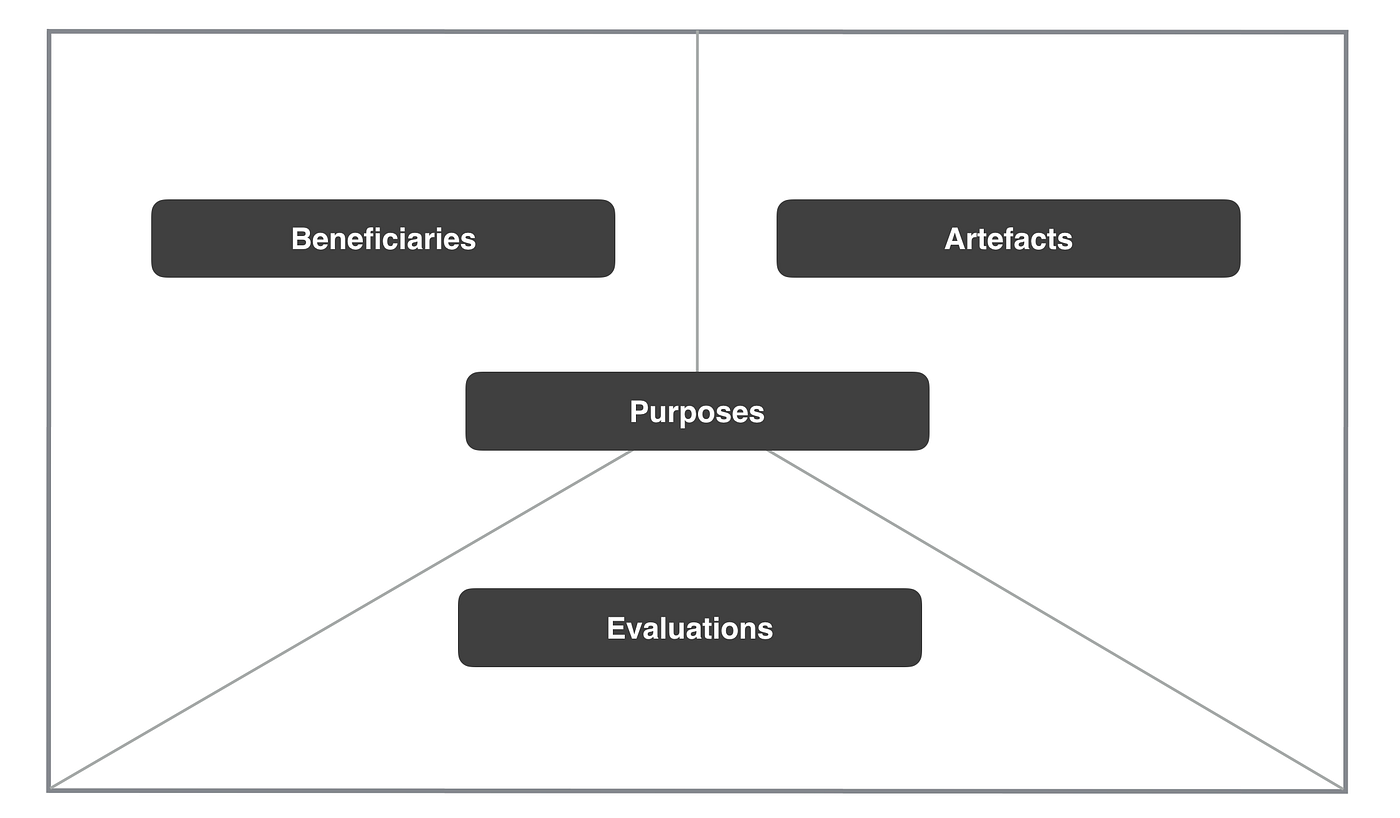
When we will gain more experience with the new design process, we will also learn new methods for organising the project work with design arenas. I’d be more than happy to hear from you when you come up with practices that work for you.
Where should I start?
If you are not sure where to start your process, use the method from applied arts as described in earlier blog post: start sketching ideas for the artefacts. Analyse these ideas to find out what underlying purposes they are best suited for, and for which beneficiaries. In this way you can very quickly identify lots of initial proposals, hypotheses and open questions for all of the design arenas on your canvas. As long as you can maintain your objectivity and not fall in love with the initial ideas, this is an effective, fast and fun way to kick-start any design project.
The results will be on the wall
If you create the large canvas for the four design arenas, it will give you a good shared understanding during the project. It will also serve as the final map of the results of the design process. On the wall you can see that the artefact you have created is only one fourth of the results. You will have gained a good understanding of the whole domain that you are working on.
Keep the canvas alive after you have released the results of your project into the hands of the beneficiaries. You can refer back to it when you plan the next iterations of your designs. Remember: you will never have solved a problem.
Now the rest is up to you
In this series of blog posts, I have described why the current dominant design thinking process will need to be re-defined, presented foundational elements of the new process, and set the direction how the new process will be formulated. Next, it is your turn. Observe how you design. See if you encounter the same issues with the current process as I did. Think again how those should be optimally overcome.
Open your mind. Don’t be the prisoner of the old visualisations and vocabulary: don’t retrofit your process to the old 5-stage stage process. See if the new design presented here will help you better understand how you optimally want to design. Be critical with this new model too; modify it to your needs and take it further. Support formulating it in more tangible terms and find best practices and tools to support it. Share your experiences: write and publish your experiences. It is the only way to collectively make progress in the design profession.
It took decades for the HCD and design thinking processes to be deeply ingrained in the designer community. The next leading paradigm for design will not emerge quickly; it will likely take maybe another ten years. But it will never be there unless we start, and now the time is ripe.
Final words
I can’t repeat this too often: go read the original articles by the giants: Rittel, Nonaka & Takeuchi, and Cockton. I’m just a messenger.
[Edit: Oh, and one more thing, we added another article in the series after all.]
References
- Dilemmas in General Theory of Planning. Horst Rittel, Melvin Webber, 1973
- The New New Product Development Game, Nonaka & Takeuchi,1986
- Design isn’t a Shape and It Hasn’t Got A Centre: Thinking BIG About Excellences in Post-Centric Interaction Design, Gilbert Cockton, 2013
- New Process, New Vocabulary: Axiofact = A_tefact + Memoranda , Gilbert Cockton, 2017
- New Language, New Design, Otso Hannula, 2018

Panu Korhonen is a designer at Nordkapp who sometimes wonders why things are done the way they are done.
In his projects he wants to create designs that save the world.