Re-thinking design thinking part V: Tools for the new design process
·
Re-thinking design thinking part V: Tools for the new design process
The current design thinking process is rigid, slow and focuses on wrong things. Earlier in this series of blog posts I have so far shown why, and then presented the new design process.
Now when the process starts to get settled down and we gain experience how the model is used in practice, we start to develop the first tools that support the new process. But before that, let’s dig a bit into the discussion that the first blog posts raised.
The discussion so far
I appreciated highly Vladimir Dimitroff’s comment “‘empathise’ should not be a one-off step, but an on-going parallel line throughout the entire process. User (customer) perspective validation should accompany every creative activity along the path to a desired result.” This reminded me of one practice that I’ve had for many years now that doesn’t fit at all the traditional 5-phase process.
I nowadays practically never do primary user/consumer research without concept ideas as stimulus materials. I can go out to the field and observe, interview and analyse what our planned beneficiaries do. But because the time with those people is so valuable, I have always with me some initial concept ideas. After the first analysis where we try to minimise observer effect, we can move to further discussions about how things might be, inspired by the concept ideas we had so far. This requires that we have ideas and very initial prototypes before we step into the ‘empathize phase’. Therefore, empathising is parallel to the ideation, prototyping and testing, just as you point out.
In the discussions the notion that the process doesn’t start from a problem has received a lot of attention. I think people in general agree that “problem” doesn’t properly describe the starting point of a design process. Coincidentally, I bumped into an interesting paper by Donald Schön: “Generative metaphor: A perspective on problem-setting in social policy” that nicely describes how important it is to frame the starting point. We should be very conscious of what kind of metaphors we use in framing the problem, as this will broadly define the solution space where we are looking for the solutions.
There was one thread in the discussion that I do disagree with. Some people were concerned that proposing new process models for design thinking might confuse those companies that haven’t yet properly taken up any design thinking, and that therefore we should rather stay with the current process and vocabulary. I don’t think this is either or: we have to both help introducing design into organisations, but at the same time the design community must look for better models and tools for future use — we must not stand still. These two are not mutually exclusive.
One interesting thought shared by both Niclas Ljungberg and Marijn Schoo was also that would we be better off if we didn’t have a process model at all — not the old one nor a new one. I think there’s a point there: designers should always think what the most appropriate model will be in each case. However, I don’t think that the old model will just go away by itself. People need models, and therefore I’d rather work towards creating one that allows and invites us to design in the optimal way. Which brings me to the next topic.
Visualizing the new process
The 5-step sequence is ingrained in our mental image of the design process. In order to replace that image in our minds, we must have new visualisations. It will probably take some time before we find the visuals that best communicate the new process model that is balanced and concentrates in the outputs rather than activities. This is one of my latest attempts at this.
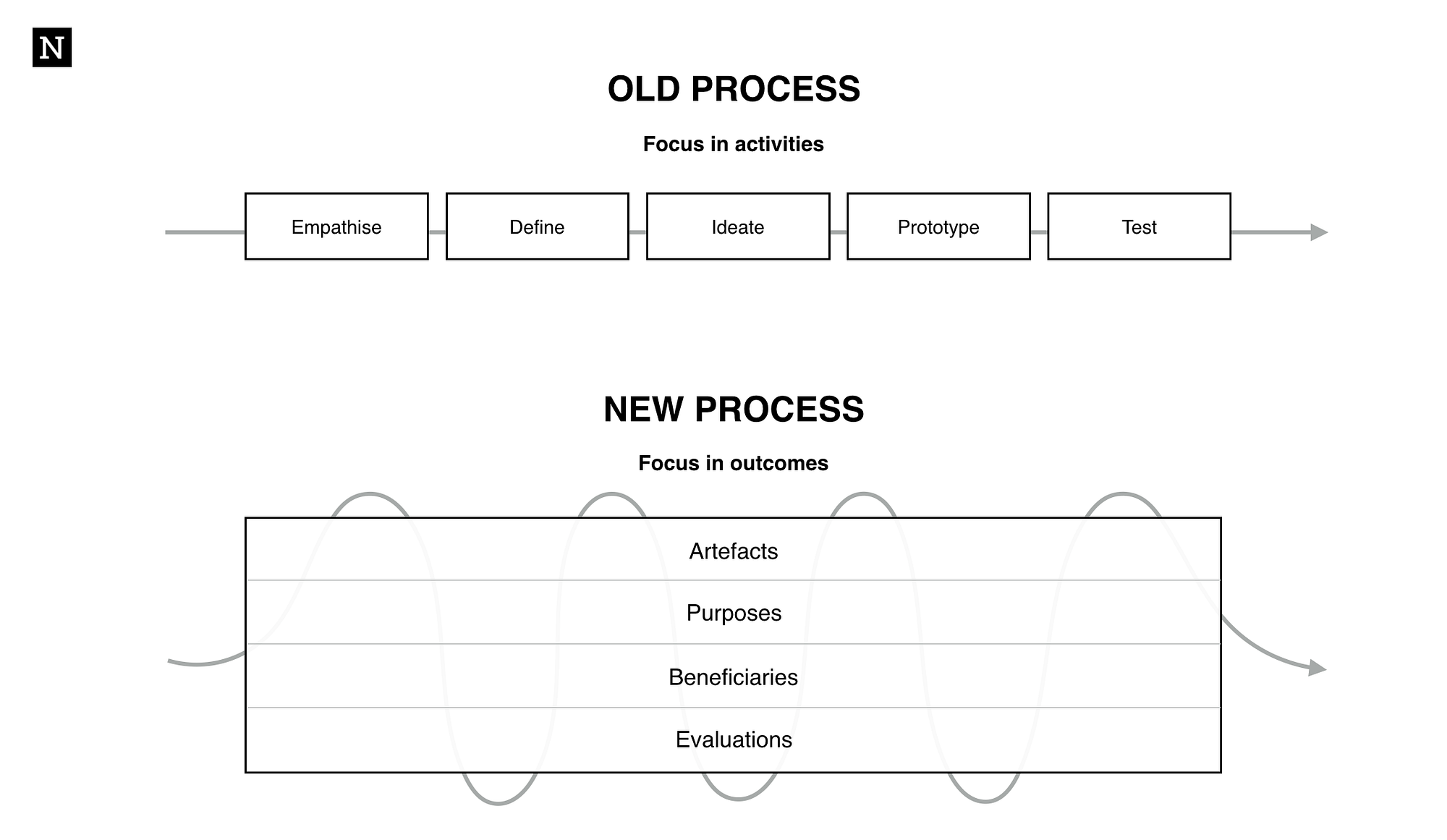
In this chart, the four design arenas evolve from initial vague understanding towards a solid understanding of each, including how the design arenas are connected.
Design arenas are not processed in a pre-defined order. Rather, we at any moment — or in sprints — identify, which arena has the most unknowns or that other arenas depend on. That arena will always have the emphasis next. There naturally needs to be a solid understanding of the available resources and time frame ahead to inform the rigorousness of the selected tasks and methods.
Design Arenas Canvas
The second new visualisation we have produced together with my colleague Sonja Krogius. She has taken the new model in use at our client, Veikkaus, which is a Finnish exclusive-right principle gambling provider that generates over one billion euros a year for the common good. They have several years of experience in integrating design with agile software development and data-driven decision making. Just like many other agile organizations, they have found it difficult to use the old design process models in their daily work. Therefore this is an excellent test bed for the new process.
Sonja has designed the first design arena canvas and made two versions of it. The first is fitted for Veikkaus and the latter is Nordkapp Design Arena Canvas (see attached). They encompass the four design arenas. Our recommendation is to print the Design Arena Canvas in as large format as you can, and place it in a prominent place in the project premises where product owners, researchers, designers and implementation work together and share an understanding of the maturity, the associated risks, and the interdependencies between the arenas. A shared board ensures that everyone in the project are up-to-date and can contribute and criticise — to help keeping design arenas balanced.
(The attached canvas is a PNG because of limitations in Medium. Drop me a line at panu(at)nordkapp.fi if you are in a dire need for a hires PDF.)
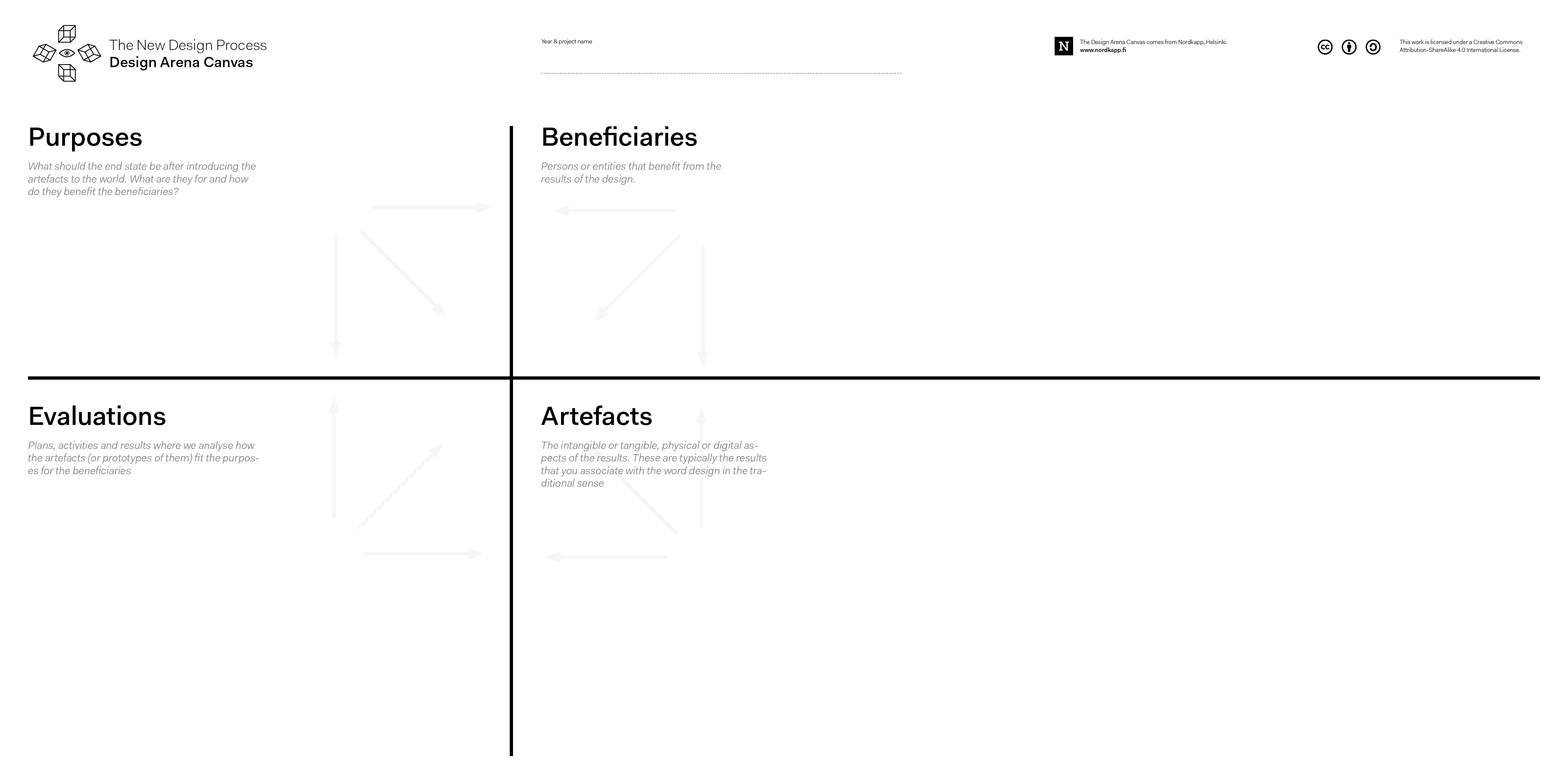
You can get a kick-start to your project by summarising the current understanding and assumptions of each arena. After that, keep the canvas updated in each design sprint: what you know about the beneficiaries (e.g. printouts of personas, interview insights), purposes (project goals, UX targets for each persona, business KPIs), artefacts (ideas, snapshots of latest designs), and evaluations (e.g. latest evaluation results and objectives of next evaluation sessions).
Stay tuned
I have been very happy to see the comments and some debating in the Design Thinking , HCD and UX related discussion groups. That is the only way to take the new ideas forward. The critiquing process will help weed out the weaker parts and also makes the strengths stronger. Please keep discussing, supporting and critiquing — and if only you can, try the new tools out there. Only through practice we will know if they are of any worth.
We will be working on this further and hopefully writing soon more of what we learn. Stay tuned.
[Edit: added part VI in the series is called “Going agile” which has a better version of the process!]
References
- Dilemmas in General Theory of Planning. Horst Rittel, Melvin Webber, 1973
- The New New Product Development Game, Nonaka & Takeuchi,1986
- Design isn’t a Shape and It Hasn’t Got A Centre: Thinking BIG About Excellences in Post-Centric Interaction Design, Gilbert Cockton, 2013
- New Process, New Vocabulary: Axiofact = A_tefact + Memoranda , Gilbert Cockton, 2017
- New Language, New Design, Otso Hannula, 2018
- Generative metaphor: A perspective on problem-setting in social policy, Donald Schön, in Metaphor and Thought, 1993
Sonja Krogius is a lead designer at Nordkapp. When not coaching design teams, she makes handmade cosmetics, spends time with her family, takes the dog out, plays Horizon Zero Dawn and enjoys gardening.
Panu Korhonen is a designer at Nordkapp who sometimes wonders why things are done the way they are done.
In his projects he wants to create designs that save the world.